

 The Rare Stone Collection
What Certifications Actually Matter in High-End Gemstone Jewelry?
What Certifications Actually Matter in High-End Gemstone Jewelry? (2026 Guide)
In the world of luxury gemstones, a beautiful sparkle isn't enough. When you are investing in a Natural Blue Sapphire, a Vivid Green Emerald, or a Pigeon Blood Ruby, you aren’t just buying a stone; you are buying its history, its rarity, and its purity.
But how do you know if that "unheated" sapphire is truly untreated? This is where gemstone certification becomes the most important document in your safe. In 2026, the market is flooded with lab reports, but not all of them hold the same weight.
Why Certification is Non-Negotiable for Luxury Jewelry
A certificate is an independent third-party blueprint of your gemstone. It protects the buyer from
-
Synthetic/Lab-Grown Stones: Identifying man-made lookalikes.
-
Undisclosed Treatments: Detecting heat, beryllium diffusion, or oiling.
-
Origin Falsification: Verifying if a stone is truly from Kashmir, Burma, or Colombia.
Top Global Certifications for High-End Gemstones
If you are dealing in international luxury markets, these three names are the "Gold Standard."
1. GIA (Gemological Institute of America)
The GIA is the world’s most respected authority. They invented the 4Cs and are known for their incredibly strict grading. A GIA report for a colored stone is a global passport—it is accepted by every major auction house and high-end jeweler from New York to Hong Kong.
2. GRS (GemResearch Swisslab)
When it comes to colored gemstones (Rubies and Sapphires), GRS is often the preferred choice for connoisseurs. They are famous for their "color branding," such as the coveted "Pigeon Blood Red" for Rubies and "Royal Blue" for Sapphires.
3. IGI (International Gemological Institute)
IGI is a powerhouse for finished jewelry. If you are buying a diamond-studded necklace or a gemstone bracelet, IGI provides excellent "Jewelry Reports" that certify not just the center stone, but the entire piece, including the gold purity and side diamonds.
The Role of IIGJ in the Indian Luxury Market
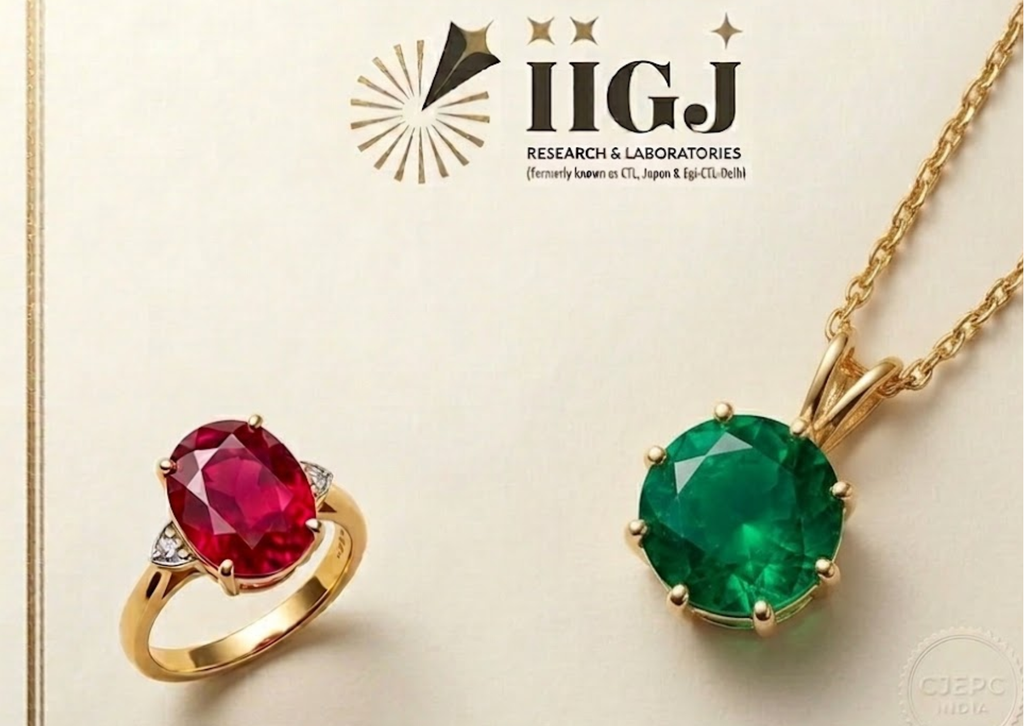
For the Indian gemstone industry, the Indian Institute of Gems & Jewellery (IIGJ)—supported by the GJEPC (Gem & Jewellery Export Promotion Council)—plays a vital role.
Why IIGJ Certification Matters:
-
Government-Backed Credibility: As a project of the GJEPC, under the Ministry of Commerce and Industry, IIGJ reports carry immense trust within India and the Middle East.
-
Advanced Lab Technology: IIGJ labs use state-of-the-art technology (like FTIR and EDXRF) to identify even the most advanced gemstone treatments.
-
Local Trust, Global Standards: For a buyer in India, an IIGJ certificate offers peace of mind that the stone has been tested by experts who understand the nuances of the local market while following international protocols.
-
Accuracy in Identification: Whether it is a Natural Yellow Sapphire (Pukhraj) or a Navratna set, IIGJ provides highly accurate identification that is widely respected by traditional Indian jewelers and modern investors alike.
What Should You Look for in a Certificate?
When you receive a report, ensure it includes these four critical elements:
-
Identification: Confirms the species (e.g., Natural Corundum)
-
Treatment Status: Must state "No indications of heating" for investment-grade stones.
- Origin: Highly important for the value of Rubies, Sapphires, and Emeralds
- Security Features: Look for a QR code, hologram, or digital verification link to ensure the report isn't a forgery.
Final Verdict: Which One Should You Choose?
-
For Global Investment: Go for GIA or GRS.
-
For Finished Jewelry Sets: IGI is highly efficient and detailed
- For Authenticity in India: IIGJ is an excellent, trustworthy, and recognized authority
SEO Keywords Included: High-end gemstone jewelry, gemstone certification 2026, GIA vs GRS, IIGJ certification India, natural sapphire certificate, luxury jewelry investment, emerald origin report, authentic gemstone lab.
In the high-end jewelry market, the difference between a $1,000 stone and a $10,000 stone often comes down to a single piece of paper: the Lab Certificate. For collectors and investors, a gemstone without a reputable report is just a "pretty rock."
If you are buying or selling investment-grade stones like Unheated Blue Sapphires, Zambian Emeralds, or Pigeon Blood Rubies, you need to understand which laboratories hold the most weight in 2026.
Why "Self-Certification" is a Myth in High-End Jewelry
Many local sellers issue their own "cards of authenticity." In the luxury segment, these are effectively worthless. A true certification must come from a Third-Party Independent Laboratory.
An independent lab has no financial interest in the sale of the stone. Their only job is to provide an unbiased scientific analysis of the stone’s:
-
Species and Variety (e.g., Natural Beryl, Emerald)
-
Weight (Calculated to the third decimal point)
-
Treatment Status (The most critical factor in price)
-
Country of Origin (Determining if it's from a premium location like Burma or Colombia)
The Big Three: Global Leaders in Gemology
GIA (Gemological Institute of America)
The GIA is the undisputed leader in diamond grading, but their Colored Stone Identification & Origin Reports are also the gold standard.
-
The Benefit: Their strictness is legendary. If GIA says a stone is "Unheated," the global market accepts it as absolute truth.
-
Best For: High-value investment stones being sold at international auctions (Sotheby’s, Christie’s).
GRS (GemResearch Swisslab)
GRS is a private independent lab based in Switzerland. They specialize in colored gemstones.
-
The Benefit: They popularized the terms "Pigeon Blood Red" and "Royal Blue." A GRS certificate with these specific color grades can increase a stone's value by 30-50%.
-
Best For: Premium Rubies and Sapphires.
SSEF & Gübelin
These are the "elite" Swiss labs. They are usually reserved for stones worth six or seven figures. If you have a historic, museum-quality gemstone, these are the only names that matter.
IIGJ: The Authority for the Indian Luxury Market
For jewelers and customers in India, the Indian Institute of Gems & Jewellery (IIGJ) is a cornerstone of trust. Established by the GJEPC and supported by the Ministry of Commerce, IIGJ serves as a bridge between Indian heritage and global scientific standards.
Why IIGJ is Essential for Your Collection:
-
GJEPC Backing: Being a government-supported initiative, it carries a level of official credibility that private local labs cannot match.
-
Advanced Instrumentation: IIGJ labs utilize FTIR (Fourier Transform Infrared Spectroscopy) and X-Ray Fluorescence to detect synthetic growth and trace elements. This is vital for distinguishing between a natural stone and a high-tech lab-grown mimic.
-
Navratna Specialization: IIGJ understands the cultural importance of stones like Natural Yellow Sapphire (Pukhraj) and Hessonite (Gomed). Their reports are tailored to the specific needs of the Indian market while maintaining international accuracy.
-
Local Accessibility: For high-end showrooms in India, IIGJ offers world-class grading without the risk and expense of shipping stones to Switzerland or the USA.
Understanding Treatments: What the Certificate Reveals
A lengthy, detailed blog must address what happens behind the lab doors. Most gemstones are treated to improve their look, but in high-end jewelry, Natural is King.
-
Heat Treatment: Common in Sapphires. A "No Heat" certificate can double the price.
-
Oiling: Standard for Emeralds. A certificate will specify if it is "Minor," "Moderate," or "Significant" oiling. Luxury buyers always look for "Insignificant to Minor Oil."
-
Glass Filling: A major red flag. Reputable labs like IIGJ or GIA will clearly identify this, protecting the buyer from overpaying for a low-quality, composite stone.
How to Verify Your Certificate
In 2026, digital security is as important as the stone itself. Most top-tier labs, including IIGJ, now include:
-
QR Code Verification: Scan the code to see the report on the lab's official database.
-
Holograms: To prevent physical tampering.
-
Micro-printing: Features that are invisible to the naked eye but visible under a loupe.
Conclusion: The Value of Peace of Mind
When you buy a piece of high-end jewelry, you are buying a legacy. Whether it is a GIA report for a global auction or an IIGJ certificate for a trusted local heirloom, the report is your insurance policy. It ensures that the "Luxury" you are paying for is real, rare, and radiant.
At Zovina, we don’t just create jewelry—we craft timeless expressions of luxury.